Medical AI is transforming healthcare. It helps doctors detect diseases earlier, analyze scans faster, and support treatment planning. From radiology to pathology, AI already influences real clinical decisions.
But one question remains: can medical AI be safe without perfect data?
The short answer is no. And the reason lies in how AI learns.
How Medical AI Learns
AI does not think like a doctor. It learns patterns from data.
During training, models are fed large datasets such as X-rays, CT scans, MRI images, pathology slides, and dermatology photos. Experts label these images by marking tumors, fractures, or abnormalities.
These labels are known as ground truth.
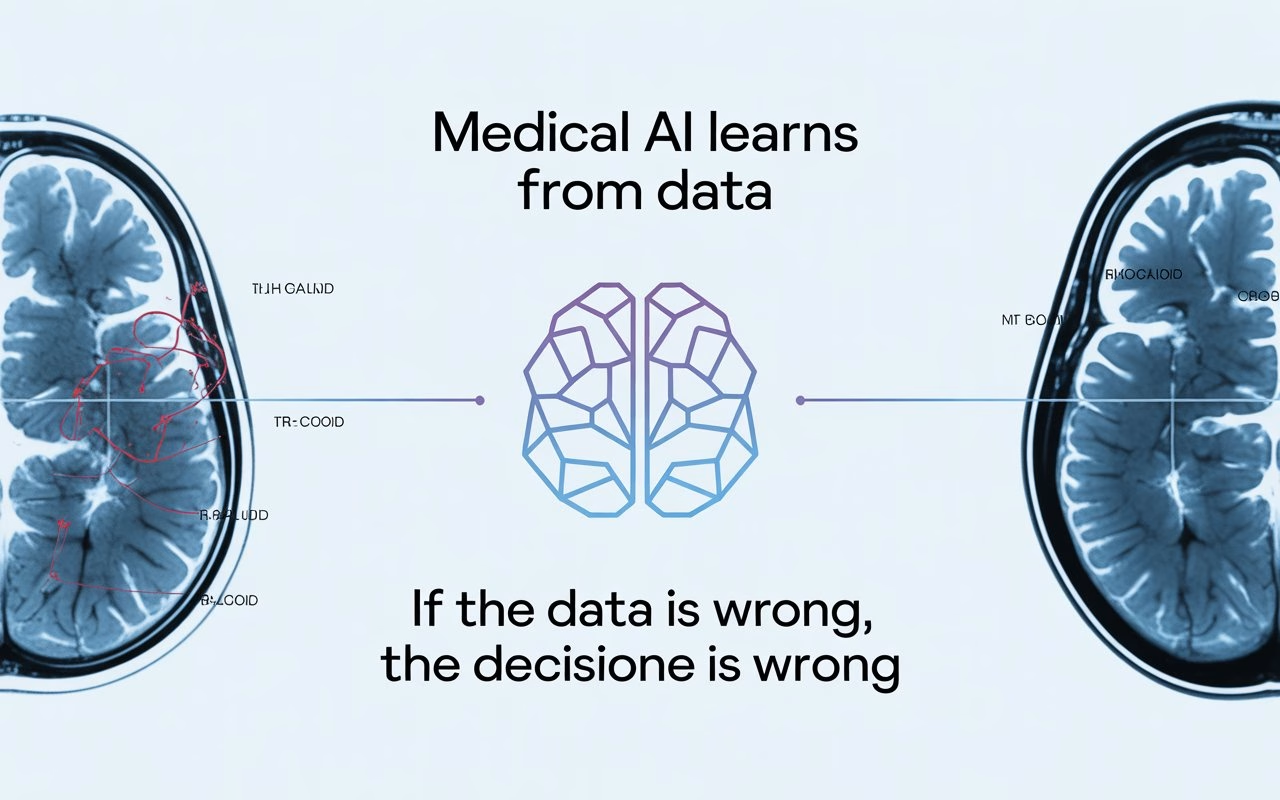
If the ground truth is wrong, the AI learns the wrong pattern.
AI systems reflect the data they receive. If the data is inaccurate or inconsistent, the output will be too.
Why Data Quality Matters
Perfect data is rare in healthcare. Images can be unclear. Experts may interpret scans differently. Errors during labeling can happen.
At scale, even small mistakes matter.
For example, a slightly incorrect tumor boundary can affect its size. Tumor size influences staging, and staging affects treatment decisions. A small annotation error can lead to a serious clinical impact.
Studies from institutions like Stanford and Harvard show that data quality and diversity directly affect AI performance. Poor data reduces reliability.
Reliable Data Over Perfect Data
Safety does not require flawless data. It requires reliable data built through strong processes:
- Clear annotation guidelines improve consistency
- Multi-level quality review reduces errors
- Diverse datasets prevent bias
For instance, in dermatology, conditions appear differently across skin tones. Without diverse data, AI systems may fail for certain groups.
Safety comes from structure, not perfection.
Human Oversight Still Matters
AI should support doctors, not replace them.
Even accurate models can make mistakes. A radiologist reviewing AI output adds a safety layer. A pathologist verifying results helps prevent missed diagnoses.
The safest systems combine AI efficiency with human judgment.
Data Annotation Builds Trust
In medical AI, data is the foundation.
Algorithms depend on well-annotated datasets. If the data is weak, the system becomes unreliable.
Healthcare runs on trust. Doctors must trust their tools. That trust begins with high-quality medical data annotation.
Building Safer AI with Medrays
Medical data annotation is a clinical responsibility. At Medrays, we provide structured medical data labeling for healthcare AI. Our approach includes trained medical annotators, clear protocols, and multi-level quality checks across radiology, pathology, and dermatology.
We focus on accuracy, consistency, and reliability.
Conclusion
Medical AI does not need perfect data to be safe. But it depends on responsible data practices. Reliable annotation, strong review systems, and diverse datasets are essential.
Safe medical AI starts with reliable data.