The Hidden Costs of Poor Annotation in Healthcare AI

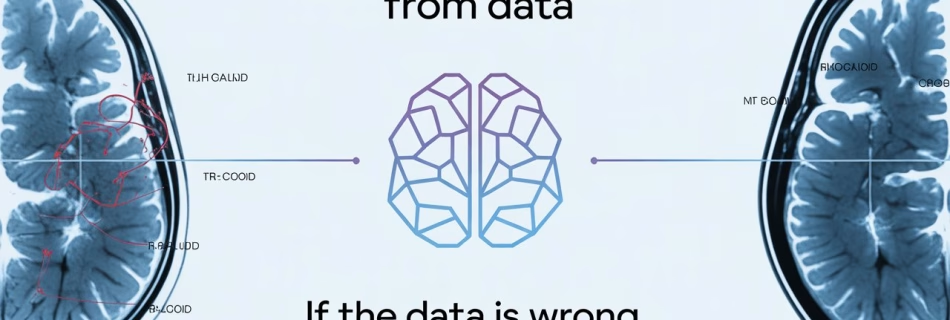
Every AI system in healthcare learns the same way a student does. Unlike humans, AI learns from data. By analyzing patterns and repeated examples, it improves its responses over time. If the examples are clear and correct, AI learns effectively. However, if they are confusing or inaccurate, it develops the wrong understanding from the beginning. …

Why MRI AI Fails Without High-Quality Annotation

Artificial intelligence is now a visible part of modern radiology. Many hospitals use AI tools to support doctors while reading MRI scans. These systems can process hundreds of images in seconds, highlight unusual areas, and compare patterns across cases. But speed does not guarantee accuracy. MRI scans show detailed images of soft tissues, organs, and …

Can Medical AI Be Safe Without Perfect Data?

Medical AI is transforming healthcare. It helps doctors detect diseases earlier, analyze scans faster, and support treatment planning. From radiology to pathology, AI already influences real clinical decisions. But one question remains: can medical AI be safe without perfect data? The short answer is no. And the reason lies in how AI learns. How Medical …

Digital Biomarkers: Everyday Data as Health Indicators

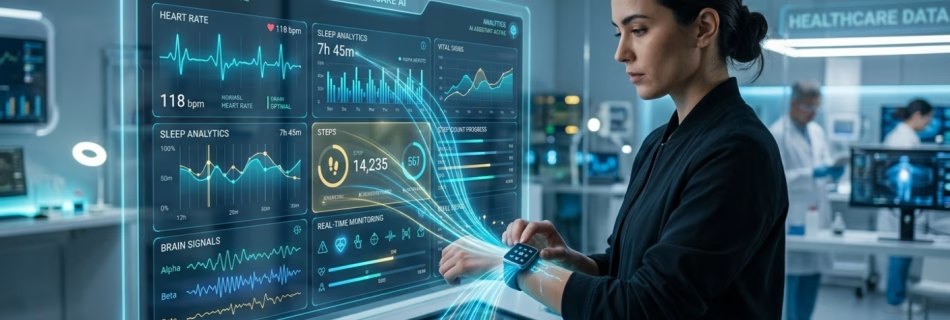
Healthcare is no longer limited to hospitals and lab tests. Today, health data is generated throughout the day as people go about their normal routines. Smartphones, wearable devices, and health apps continuously collect signals about how the body functions. These signals are known as digital biomarkers. They help doctors, researchers, and healthcare technology companies understand …

AI Smart Capsules for Colorectal Screening

For many people, a colonoscopy feels uncomfortable even before it starts. The preparation, sedation, and hospital visit make it feel invasive and inconvenient. Because of this, many people delay or avoid screening, even when doctors strongly recommend it. Now, a simple pill can change that. Researchers at Johns Hopkins University are developing a small, vitamin-sized …

How Micro Medical Robots Rely on Imaging Data

Healthcare technology is evolving rapidly, and micromedical robots are one of its most exciting advancements. These tiny devices are designed to travel inside the human body and perform tasks that once seemed impossible. Scientists are developing robots that can move through blood vessels, deliver drugs directly to diseased areas, and assist in highly precise procedures. …

Why Dermatology Data Labeling Matters in Early Cancer Detection

Skin cancer is one of the most common cancers in the world. The good news is this. When doctors detect it early, treatment becomes much easier and more effective. Early diagnosis can save lives. Today, artificial intelligence is helping doctors detect skin cancer at earlier stages. But AI does not work on its own. It …

The Hidden Role of Data Labeling in Modern Dentistry

Modern dentistry now relies on digital X-rays, 3D scans, and AI tools. These systems help dentists diagnose faster and plan treatments more accurately. But behind every smart dental solution sits something most people never notice. That hidden layer is data labeling. Data labeling teaches AI how to understand dental images and clinical records. Without accurate …

Quality, Accuracy, and Trust: Key Pillars of Healthcare AI

In healthcare, even a small mistake can have serious consequences. As artificial intelligence becomes part of diagnosis, imaging, and clinical decision-making, performance alone is not enough. What truly determines whether AI succeeds in healthcare comes down to three essential pillars: quality, accuracy, and trust. AI has the potential to detect diseases earlier, support faster decisions, …

The Next Decade of Medical Data Labeling

Healthcare is changing fast. Artificial intelligence now helps doctors detect diseases earlier, read scans faster, and improve patient care. But none of this works without high-quality medical data labeling. Medical data labeling turns raw healthcare data into structured information that machines can understand. This includes tagging X-rays, annotating medical reports, and labeling clinical images. Over …