Skin cancer is one of the most common cancers in the world. The good news is this. When doctors detect it early, treatment becomes much easier and more effective. Early diagnosis can save lives.
Today, artificial intelligence is helping doctors detect skin cancer at earlier stages. But AI does not work on its own. It learns from data. And that data must be accurate, well-organized, and clearly labeled.
This is where dermatology data labeling becomes critical.
The Growing Role of AI in Dermatology
Doctors use AI tools to analyze images of the skin. These images may show moles, lesions, rashes, or other skin conditions. AI systems compare new images with thousands of previous examples. Based on patterns, they can suggest whether a lesion looks harmless or suspicious.
Some tools even help doctors measure changes in size, color, or texture over time. This improves monitoring and reduces the chance of missing early warning signs.
But AI can only be as reliable as the data used to train it. If the training data is poor, the output will be poor.
In healthcare, mistakes can be serious. That is why high-quality data labeling matters.
What is Dermatology Data Labeling?
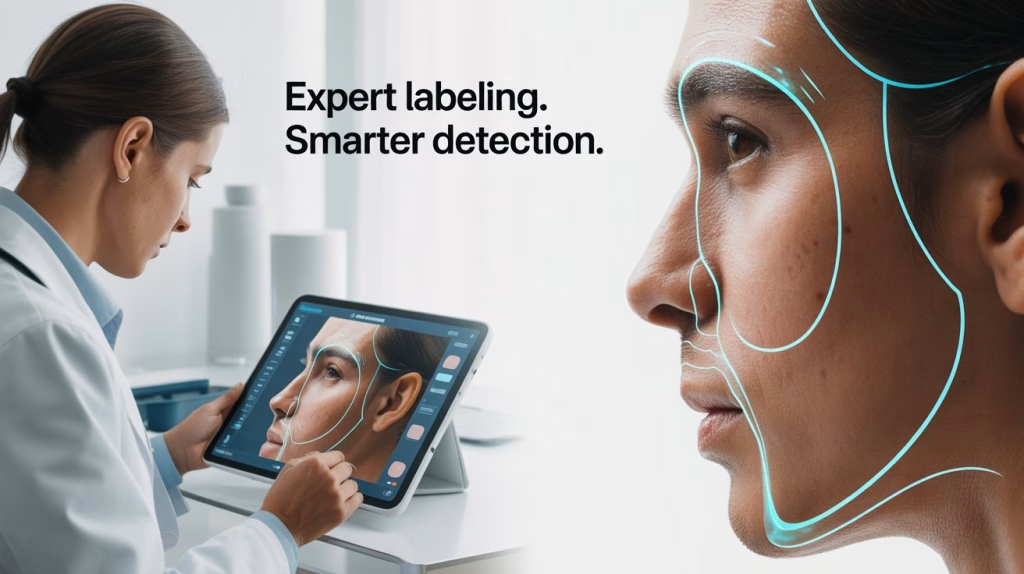
Dermatology data labeling is the process of tagging medical data so AI systems can learn from it.
In simple terms, experts review medical images and add correct annotations. For example, they may:
- Mark the exact boundary of a mole
- Identify whether a lesion is benign or malignant
- Label different types of skin cancer
- Tag features such as asymmetry, border irregularity, or color variation
These annotations teach AI what to look for. Over time, the system learns patterns linked to specific conditions.
Without proper labeling, AI cannot understand the difference between a harmless mole and early melanoma.
Why Early Detection Depends on Accurate Labeling
Skin cancer often begins with subtle changes. A small color shift. A slight irregular border. A tiny increase in size.
These changes can be easy to overlook, especially in busy clinical settings. AI tools help by scanning images carefully and consistently.
However, AI must first learn what those subtle warning signs look like. If dermatology images are labeled incorrectly, the system may learn the wrong patterns.
For example:
- If a malignant lesion is labeled as benign, the AI may fail to flag similar dangerous cases.
- If image boundaries are poorly marked, the system may misinterpret shape and size.
- If rare cancer types are not properly tagged, the model may ignore them in real practice.
In early cancer detection, even small data errors can lead to serious consequences. Accurate labeling reduces that risk.
The Importance of Medical Expertise in Annotation
Dermatology data labeling is not simple image tagging. It requires medical knowledge.
Only trained professionals understand how to identify complex skin conditions. They can distinguish between similar-looking lesions. They know how lighting, skin tone, and image quality can affect interpretation.
Medical annotators also follow clinical guidelines. They ensure consistency across large datasets. This consistency helps AI systems learn stable and reliable patterns.
When annotation teams lack medical understanding, errors increase. In healthcare AI, accuracy is not optional. It is essential.
Handling Diversity in Skin Data
Skin cancer does not look the same on every person. Skin tone, age, genetics, and environmental exposure all influence appearance.
Historically, many datasets have underrepresented darker skin tones. This creates bias in AI systems. When models train mostly on lighter skin images, they may struggle to detect conditions on darker skin.
Proper dermatology data labeling addresses this issue. Teams must ensure:
- Diverse skin tones are included
- Different age groups are represented
- Multiple image sources and devices are used
- Rare conditions are not ignored
Balanced datasets help AI systems perform more fairly and accurately across populations.
Early cancer detection should work for everyone. Good labeling makes that possible.
Improving Clinical Decision Support
AI does not replace dermatologists. Instead, it supports them.
When trained on well-labeled data, AI systems can:
- Flag high-risk lesions for closer review
- Prioritize urgent cases
- Reduce diagnostic time
- Assist in teledermatology consultations
In remote areas, patients may not have quick access to specialists. AI-powered tools can provide preliminary screening. This speeds up referrals and improves patient outcomes.
But none of this works without accurate annotations at the foundation.
Data labeling builds the base layer of trust in healthcare AI.
Reducing False Positives and False Negatives
Two common problems in AI diagnostics are false positives and false negatives.
A false positive means the system flags something as cancer when it is not. This causes stress, unnecessary biopsies, and higher costs.
A false negative means the system misses a real cancer case. This delay can be dangerous.
Careful dermatology data labeling helps reduce both risks. When annotators clearly mark features and confirm diagnoses, AI models learn more precise distinctions.
High-quality labeled data leads to better sensitivity and specificity. In simple terms, it helps AI catch real cancer cases while avoiding unnecessary alarms.
The Future of Dermatology AI
The future of dermatology will rely more on digital imaging and intelligent tools. As datasets grow, AI models will become more advanced.
Researchers are already exploring:
- Predicting cancer risk based on image patterns
- Tracking lesion changes over time
- Combining clinical notes with image data
- Using AI in mobile apps for early screening
All these innovations depend on structured, accurate, and ethically labeled data.
Without strong data foundations, advanced algorithms cannot deliver safe results.
How Medrays Supports Early Cancer Detection
Early skin cancer detection depends on precision. Precision depends on data. And data depends on expert labeling.
Medrays provides specialized dermatology data labeling services designed for healthcare AI development. Our team includes trained medical professionals who understand clinical guidelines and diagnostic standards.
We support:
- Image segmentation for skin lesions
- Bounding box and polygon annotations
- Classification of benign and malignant conditions
- Multi-class labeling for different skin cancer types
- Quality assurance with strict review protocols
- Diverse dataset handling to reduce bias
We focus on accuracy, consistency, and compliance. Every dataset goes through structured validation processes to ensure reliability.
By delivering high-quality dermatology annotations, Medrays helps AI developers build safer and more effective tools for early cancer detection.