
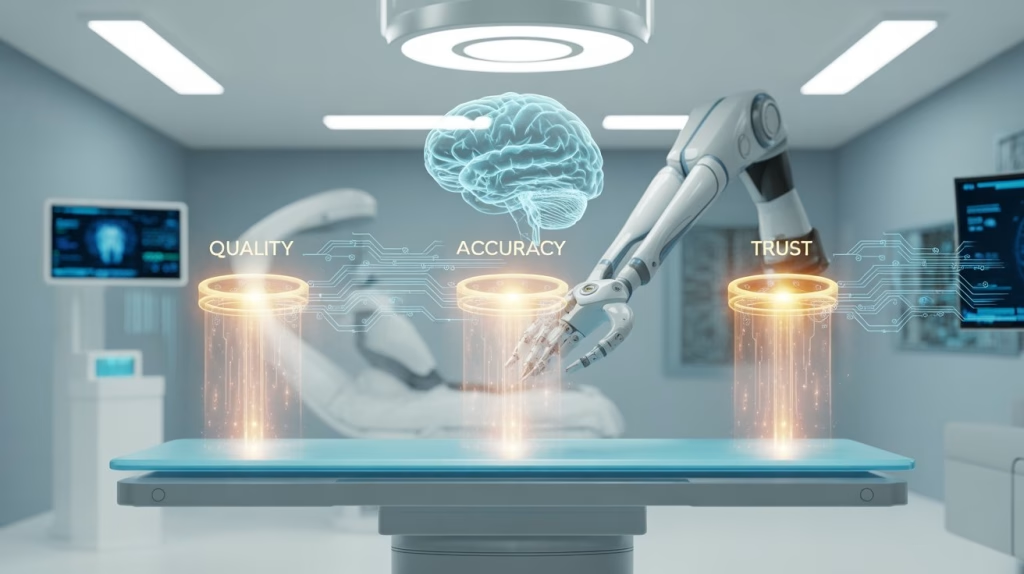
In healthcare, even a small mistake can have serious consequences. As artificial intelligence becomes part of diagnosis, imaging, and clinical decision-making, performance alone is not enough. What truly determines whether AI succeeds in healthcare comes down to three essential pillars: quality, accuracy, and trust.
AI has the potential to detect diseases earlier, support faster decisions, and reduce clinical workload. But without strong foundations, even the most advanced systems can fail. In healthcare, safety and reliability are non-negotiable.
Why AI Needs Strong Foundations
Healthcare is unlike any other industry. AI systems analyze medical images, patient records, and lab data that directly affect patient outcomes. This means results must be dependable every single time.
Speed and automation are valuable, but they cannot come at the cost of correctness. This is why quality, accuracy, and trust must be built into healthcare AI from the very beginning.
Quality: The Starting Point of Reliable AI
Quality is where healthcare AI begins. AI learns from data, and if that data is unclear, inconsistent, or incomplete, the system will learn the wrong patterns.
Healthcare data includes imaging studies, clinical notes, lab reports, and patient histories. These datasets must be clean, properly structured, and accurately labeled. A poorly tagged X-ray or an incomplete report can lead to incorrect predictions later.
High-quality healthcare data means:
- Clear and usable images and records
- Accurate labels and annotations
- Consistent formats across datasets
- Minimal errors and missing information
When data meets these standards, AI systems learn more effectively. Without quality, accuracy simply cannot exist.
Accuracy: Results Clinicians Can Rely On
Accuracy ensures that AI outputs are correct and clinically meaningful. In healthcare, this includes detecting abnormalities, identifying risks, and supporting diagnostic decisions.
Even small error rates can be dangerous when medical decisions are involved. That is why healthcare AI must be rigorously tested, validated, and continuously improved.
Accuracy depends on:
- Well-trained models
- High-quality annotated data
- Ongoing testing and performance monitoring
- Human review and correction
AI is not meant to replace clinicians. It is meant to support them. By highlighting areas of concern or patterns that require attention, AI helps doctors work more efficiently while reducing the risk of oversight.
However, accuracy is not permanent. Medical practices evolve, imaging technology improves, and disease patterns change. AI systems must be updated regularly to remain reliable.
When accuracy is consistent, confidence grows. And confidence leads to trust.
Trust: The Key to Real World Adoption
Trust determines whether healthcare professionals and patients are willing to use AI at all. Without trust, even high-performing systems may never be adopted.
Trust in healthcare AI comes from:
- Transparency in how systems work
- Proven validation and testing
- Human oversight and accountability
- Ethical handling of patient data
Clinicians need to understand how AI supports their decisions. Patients need assurance that their data is secure. Healthcare organizations need confidence that systems meet clinical and regulatory standards.
Trust grows over time through consistent real-world performance. When AI proves that it reduces errors, saves time, and improves outcomes, adoption naturally follows.
How Quality, Accuracy, and Trust Work Together
These three pillars are deeply connected. One cannot exist without the others.
High-quality data improves training.
Better training improves accuracy.
Consistent accuracy builds confidence.
Trusted systems see wider adoption and continued improvement.
Breaking any part of this cycle weakens the entire system. Poor data reduces accuracy. Lower accuracy makes people lose trust. Without trust, even advanced AI tools remain unused.
That is why these pillars must be treated as essential standards, not optional goals.
The Human Role Behind Healthcare AI
Despite its power, AI depends on human expertise. Clinicians, data annotators, researchers, and engineers all play critical roles in ensuring safety and reliability.
Medical data annotation is especially important. Experts must carefully label images and clinical data, so AI systems can learn correct patterns. This process requires medical knowledge, precision, and strict quality control.
Human review ensures AI remains aligned with real clinical needs. The success of healthcare AI depends on this collaboration between humans and technology.
The Future of AI in Healthcare
AI will continue to support earlier diagnosis, personalized treatment, and improved patient monitoring. But these benefits will only be possible if systems remain reliable, ethical, and safe.
Future progress also depends on diverse datasets, ongoing audits, and continuous human oversight. Healthcare AI is not about replacing doctors. It is about giving them better tools to deliver better care.
How Medrays Supports These Pillars
At Medrays, quality, accuracy, and trust are responsibilities, not just objectives.
We provide high-quality medical data annotation and validation services designed for real-world clinical use. Our expert teams work with medical images, clinical text, and complex datasets to ensure consistency, precision, and reliability.
Through strict quality control, multi-level reviews, and domain-specific guidelines, we help healthcare AI systems perform safely and effectively. This enables organizations to reduce risk, improve model performance, and earn the trust of clinicians and patients.
When quality drives accuracy, trust follows. And with trust, healthcare AI can truly make a meaningful difference.