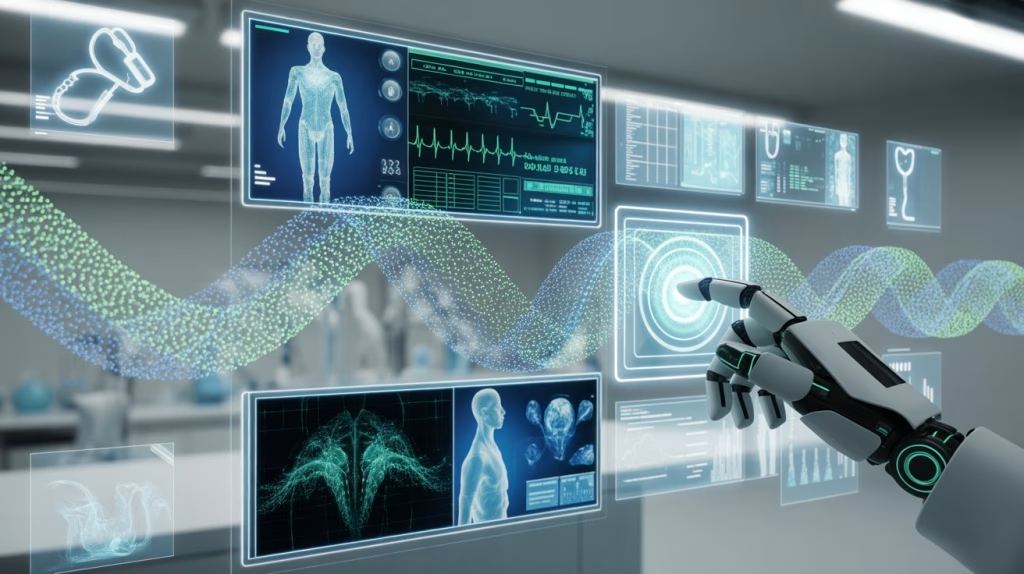
Artificial intelligence is reshaping modern healthcare. From disease detection to clinical decision support, AI systems are becoming deeply involved in how care is delivered. At the heart of these systems lies medical data annotation.
Many organizations still view annotation as a one-time task they can reuse forever. In reality, medical annotation is an ongoing process. Treating it as a one-time effort can limit the effectiveness and safety of healthcare AI.
Understanding why annotation must be continuous is essential for building reliable and future-ready medical AI systems.
Medical Data is Always Evolving
Healthcare data is created every day, and hospitals generate new imaging scans, diagnostic reports, and clinical records constantly. Patient populations change over time, and disease patterns evolve.
New imaging equipment and software updates change how data looks and behaves. Older annotations may no longer reflect current data characteristics.
Continuous annotation ensures that new data is accurately labeled. It helps AI models stay aligned with real-world clinical environments rather than outdated datasets.
Clinical Knowledge Does Not Stand Still
Medical science advances rapidly. Diagnostic criteria, disease definitions, and treatment guidelines are updated based on new research and clinical evidence.
Older annotations may not match today’s medical standards. This can lead to inaccurate model predictions and reduced clinical trust.
Ongoing annotation allows datasets to be updated in line with the latest medical knowledge. This keeps AI systems medically relevant and clinically reliable.
AI Models Improve Through Repeated Learning
Healthcare AI systems improve through continuous learning. Models are trained, tested, deployed, and refined over time.
When teams use models in real clinical settings, they identify new edge cases and errors. These insights show where annotations are incomplete or incorrect.
Continuous annotation makes it possible to correct labels, add new categories, and improve dataset depth. This feedback loop strengthens model accuracy and performance.
Data Drift Requires Constant Attention
Data drift is a common challenge in healthcare AI. It occurs when incoming data differs from the data used for training.
Shifts in patient demographics, clinical practices, or technology can all cause data drift. If annotation does not evolve, model reliability drops.
Regular annotation updates help detect and address these changes. This keeps AI predictions consistent and trustworthy over time.
Reducing Bias Through Ongoing Annotation
Bias in healthcare AI can lead to unequal outcomes for different patient groups. This often happens due to imbalanced or outdated datasets.
Continuous annotation helps ensure diverse populations and conditions are accurately represented. Teams can identify gaps and correct imbalances early.
By updating labels and reviewing datasets regularly, AI systems can support fairer and safer healthcare decisions.
Annotation Quality Needs Continuous Monitoring
Annotation quality directly impacts patient safety. Even small labeling errors can affect AI predictions.
Teams cannot treat quality assurance as a one-time activity. Teams must run regular reviews, expert validation, and consistency checks.
As annotation teams expand and workflows evolve, maintaining accuracy becomes more complex. Continuous monitoring helps maintain high annotation standards over time.
Regulatory Expectations Keep Changing
Healthcare AI operates under strict regulatory oversight. Expectations around transparency, validation, and data quality continue to evolve.
Older annotations may not meet new compliance requirements. Ongoing annotation helps teams adapt quickly.
Updated labels and clear audit trails support regulatory confidence and long-term system approval.
Supporting Scalability and New Use Cases
As AI solutions expand into new medical areas, datasets must grow as well. New diseases, organs, or imaging types often require new labels.
Continuous annotation supports scalable growth, and it prevents the need to rebuild datasets from scratch.
This approach saves time, reduces cost, and accelerates innovation across healthcare AI projects.
Human Expertise and AI Tools Evolve Together
Modern annotation workflows often combine human expertise with AI-assisted tools. As models improve, they can help pre-label data.
Human experts validate and refine these outputs continuously. This collaboration evolves as tools improve.
Continuous annotation allows workflows to adapt naturally, and it ensures that human oversight remains central while improving efficiency.
Long-term AI Success Depends on Continuity
Healthcare AI is not static. It requires constant evaluation and improvement.
Medical annotation plays a central role in this process. Continuous annotation keeps models accurate, fair, and clinically useful.
Organizations that invest in ongoing annotation are better positioned to deliver safe and reliable AI-powered healthcare.
The Medrays Commitment to Continuous Medical Annotation
At Medrays, we recognize that medical annotation is not a one-time task. It is a long-term commitment to quality and accuracy.
Our approach focuses on continuous refinement, clinical expertise, and strong quality control processes. We work closely with healthcare AI teams to ensure datasets evolve with medical knowledge and technology.
By prioritizing ongoing annotation, Medrays helps build healthcare AI systems that clinicians can trust and patients can rely on.
Continuous medical annotation is the foundation of responsible healthcare AI, and Medrays is dedicated to delivering it.