
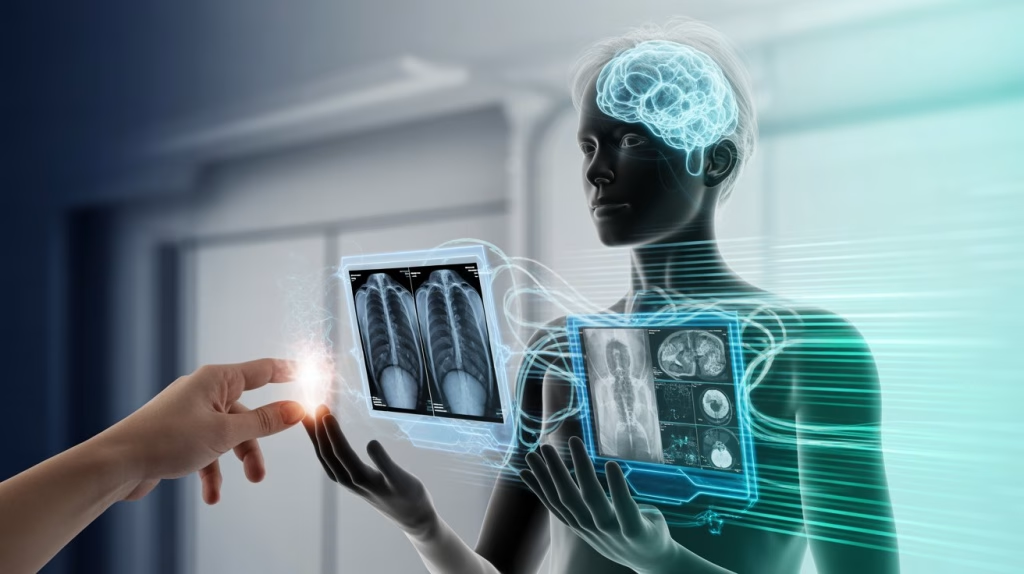
Artificial intelligence is playing a growing role in today’s healthcare systems. Many hospitals and diagnostic centers now use AI tools to support doctors when reading X-rays, CT scans, and MRI images. These systems can highlight areas of concern, reduce reporting time, and support earlier detection of diseases.
While AI often appears automatic and advanced, its reliability depends on something most people never see. Behind every successful radiology AI system is an invisible layer that determines how well it performs. This layer is human-led data labeling.
Understanding Radiology AI in Simple Terms
Radiology AI is a computer system trained to recognize patterns in medical images. It does not think or reason like a doctor. Instead, it learns by studying large numbers of images and identifying similarities between them.
Each medical image needs clear labels for this learning process to work. These labels explain what the image shows, and they indicate where an abnormality is located, what type of condition is present, or whether the image represents normal anatomy.
Without clear and accurate labels, AI cannot learn correctly.
What Data Labeling Means in Healthcare
Data labeling in radiology involves marking specific areas in medical images and attaching correct medical descriptions to them. For example, a radiologist may label a shadow in a lung scan as a tumor or mark a fracture in a bone X-ray.
These labels guide how AI learns. They teach the system how diseases appear and how healthy tissue looks. Over time, AI uses this information to make predictions on new images.
Because medical images are complex, labeling must be done carefully. Even small errors can change how AI understands a disease.
Why Accuracy is Critical
In medical imaging, tiny details can have serious meaning. A very small change in shape, color, or texture may signal the early stages of illness. If such details are missed or labeled incorrectly, AI may fail to identify a real problem or raise false alarms.
In healthcare, mistakes can affect real people. Incorrect results may cause delays in treatment or unnecessary worry for patients. This is why accuracy in labeling is not optional; it is essential.
Can Machines Label Images on Their Own
Some AI tools are designed to label medical images automatically. While this can speed up the process, it has clear limitations.
Automated systems often struggle with rare diseases, unusual cases, or early signs of illness. They lack the medical understanding needed to interpret complex images correctly. These systems also cannot fully consider patient history or clinical context.
As a result, automated labeling without human oversight can introduce errors that affect the quality of AI training.
Why Human-Led Labeling Matters
Human experts bring medical knowledge and experience to the labeling process. Radiologists understand anatomy, disease patterns, and how conditions vary from person to person.
When humans lead labeling, they can:
- Identify subtle findings that software may overlook
- Apply consistent and meaningful medical descriptions
- Review and correct errors through quality checks
This ensures that AI systems are trained on reliable data that reflects real clinical situations.
Human-led labeling does not slow down innovation. Instead, it strengthens the foundation on which AI is built.
How Better Data Improves Patient Care
When AI is trained using accurate, expert-labeled data, it becomes a valuable support tool for doctors. It can help identify potential problems earlier and assist clinicians in managing large volumes of imaging data.
Early detection often leads to better outcomes. In areas such as cancer, heart disease, and neurological conditions, identifying issues sooner can make a significant difference in treatment success.
Patients benefit from faster diagnoses, improved confidence in results, and more informed clinical decisions.
The Role of Medrays
Medrays focuses on providing high-quality medical data annotation to support healthcare AI development. We work with experienced radiologists and trained annotation teams to ensure medical images are labeled accurately and consistently.
From X-rays to advanced CT, MRI, and PET scans, Medrays works across multiple medical imaging modalities to power reliable healthcare AI. Each dataset undergoes multiple levels of review to maintain high clinical standards.
By combining human expertise with structured workflows, Medrays delivers data that is ready for real-world AI applications.
Why This Invisible Layer Matters
AI in radiology depends on trust. Doctors need confidence that AI systems are reliable and safe. That trust begins with the data used to train these systems.
Human-led labeling ensures that AI understands medical images correctly. It reduces errors, improves performance, and supports better healthcare outcomes.
The Human Foundation Behind Trusted Radiology AI
Radiology AI may appear highly automated, but its success depends on human involvement behind the scenes. Data labeling is the invisible layer that transforms raw medical images into meaningful information for AI.
As AI continues to shape the future of healthcare, human expertise will remain essential.
Medrays plays a critical role by ensuring that AI is built on accurate, clinically sound data.
Better data leads to better AI. Better AI leads to better care.