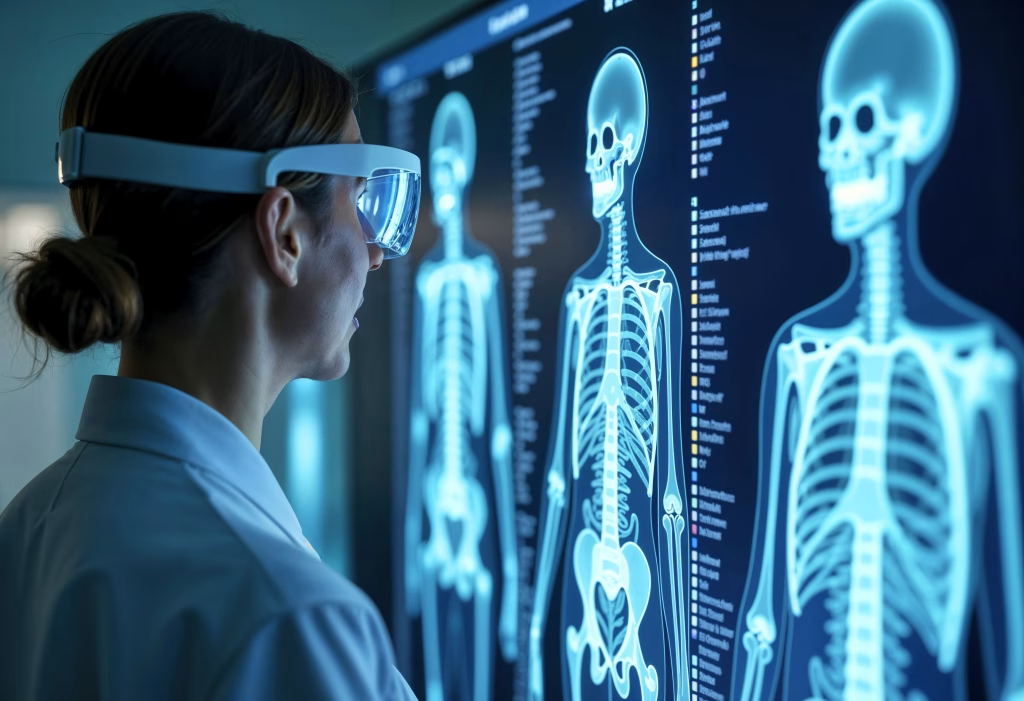
Orthopedics is entering a new era where machines are not just assisting clinicians but actively helping detect fractures, classify injuries, and support surgical planning. Hospitals worldwide are starting to use AI tools that can flag bone abnormalities in X-rays, estimate joint degeneration from MRI studies, and even predict complications ahead of time. These systems promise faster diagnoses, fewer misses, and better outcomes for patients.
Yet behind every impressive orthopedic AI model sits a quiet truth. The model is only as smart as the data it learns from. And in orthopedics, nothing matters more than how accurately that data is labeled. Every outline, fracture, tear, and subtle dark area (shadow) in a medical image must be carefully and accurately marked. Orthopedic AI cannot operate reliably without high-quality labeled imaging data.
This blog explores why orthopedic AI models depend so heavily on expert labeled imaging data and how accurate annotations are becoming the backbone of next generation musculoskeletal innovation.
Orthopedic AI is Growing Fast
Fractures and musculoskeletal problems are two of the most common reasons for hospital visits. Orthopedic imaging involves enormous amounts of data and quick decision-making. These are the exact circumstances in which AI thrives.
Today’s orthopedic AI systems can assist with:
• Fracture detection across X-rays, CT, and MRI.
• Bone age estimation in pediatric patients.
• Early osteoarthritis grading.
• Identification of ligament tears.
• Cobb angle measurement is used.
• Implant positioning assistance.
• Sports injury analysis.
Each of these use cases depends on thousands of examples to train the model. But these examples are not just images. They are images with meaning. They must be labeled with the correct structure, classification, and clinical interpretation.
This is where annotation becomes the critical factor.
Why Does AI Need Labeled Orthopedic Images?
Showing an AI system an image of a fracture alone isn’t enough for it to understand. It cannot recognize a damaged ligament without examples. It cannot identify spinal curvature or cartilage thickness unless these areas are consistently marked.
Annotation is the process of teaching AI by labeling what is important. In orthopedics, these labels help the model navigate complex anatomy and complicated patterns.
AI learns through example. High-quality annotations make medical images actionable for diagnosis and treatment.
The Complexity of Orthopedic Annotation
Annotating orthopedic images can be surprisingly complex. Bones may overlap, joint spaces can shift, fracture lines can be very thin, soft tissues may hide small rips, and subtle cartilage damage is hard to spot without expert eyes.
Annotation teams must handle:
• Boundary marking of bones and joint structures
• Identifying hairline fractures
• Defining fracture types and classifications
• Segmenting cartilage, ligaments, and tendons
• Noting swelling, misalignment, and deformities
• Marking implants and hardware positioning
This requires more than just basic labeling. It necessitates clinical insight. Annotators must understand musculoskeletal anatomy and pathology. Even minor errors, such as wrongly marking a fracture border, might mislead the model and degrade performance.
High-quality annotation guarantees that the model recognizes the correct patterns every time.
How Accurate Labeling Enhances Orthopedic AI Models
Precision annotation has a direct impact on AI performance. It influences speed, precision, reliability and clinician trust.
1. Improved Fracture Detection.
Well-labeled fracture data enables AI to distinguish between healthy bone and subtle breaks. Models trained on clean labels reduce false negatives and enhance early identification.
2. Accurate Classification.
Whether it’s a compression fracture, displaced fracture, or complex spiral pattern, the correct label allows AI to classify injuries consistently.
3. Clearer Joint Assessments.
AI uses cartilage segmentation and joint space labeling to detect early osteoarthritis and assess degeneration.
4. Improved Surgical Planning Tools.
Annotating implant sizes, angles, bone landmarks, and alignment data helps AI systems assist surgeons with planning and navigation.
5. Reliable Pediatric Assessments.
Annotating growth plates and bone ages provides models with critical information for making precise predictions in children.
High-quality labeled data serves as the blueprint for everything the model learns. When the blueprint is accurate, the AI becomes reliable.
The Dangers of Poor Annotation
When labels are inconsistent, incomplete, or clinically incorrect, orthopedic AI models suffer. They may miss fractures, misclassify injuries, or confuse anatomy. Even one mislabeled example can disrupt model learning, especially in rare conditions where each sample matters.
Poor annotation leads to:
- Inaccurate predictions
- Higher false negatives
- poor generalization in real hospital settings
- safety concerns
- Reduced clinical adoption
Hospitals and AI developers cannot afford these risks. This is why the industry is shifting toward skilled medical annotation teams with domain expertise.
The Demand for Domain-Trained Annotators
Not everyone is capable of annotating orthopedic images. Musculoskeletal imaging necessitates specific expertise. Identifying bone landmarks, distinguishing between a shadow and a fracture and understanding pathologic patterns. These tasks demand careful annotation.
Domain trained medical annotators improve the consistency and clinical correctness of datasets. They recognize the complexities of orthopedic imaging, they are capable of accurately labeling delicate structures and they implement standards across vast datasets to ensure that AI learns properly.
The difference is clear. When experts annotate, AI improves but when annotation quality drops, AI performance declines too.
Why Orthopedic AI Needs Partners Like Medrays
This is where Medrays plays a crucial role in the orthopedic AI industry. As AI usage accelerates, the demand for high-quality labeled imaging grows. Medrays provides the structure, expertise, and precision needed to support this demand.
Medrays offers:
- Expert annotators trained in orthopedic data.
- Strict quality control workflows.
- Annotation consistency across large imaging datasets.
- Clinically aligned labeling guidelines.
- Support for X ray, CT, MRI, and ultrasound workflows.
This level of precision ensures AI models learn from the best possible data. It minimizes errors, strengthens model reliability and it allows developers to build solutions that clinicians trust.
The Road Ahead
Orthopedic AI is gaining popularity and the next wave will offer even more advanced capabilities. Automated fracture detection, smarter surgical tools and deep learning algorithms enable real-time decision making. All of these advances rely on a single key element. High-quality labeled imaging data.
As healthcare continues to rely on these systems, the demand for professional medical annotation will increase. Medrays is at the forefront of this development, providing accurate orthopedic datasets to developers, hospitals, and AI teams.
The future of orthopedic AI begins with precise labeling. And accurate labeling begins with the appropriate partner.