
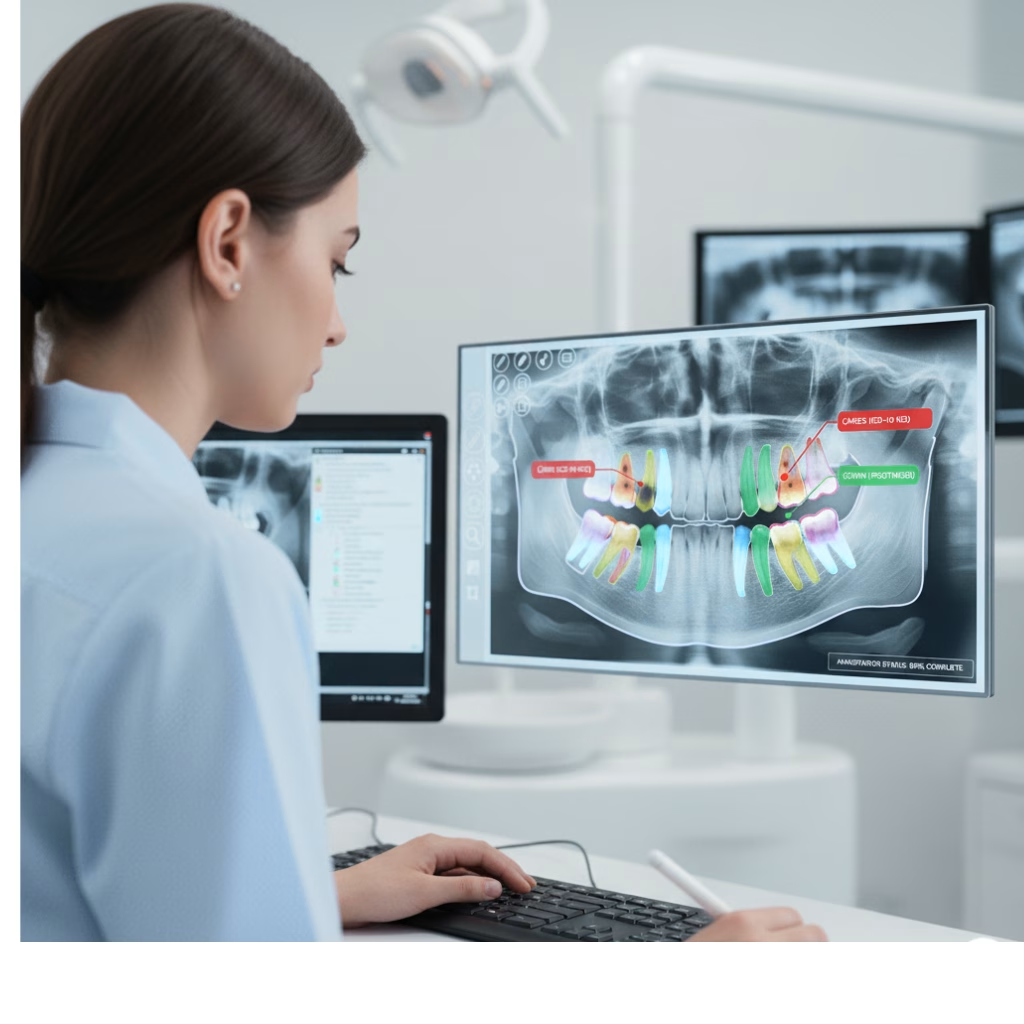
Each smile contains more information than we know. Each tooth, line, and shade in a dental image reveals information about your health. Imagine if technology could read those stories and detect cavities, bone loss, or alignment issues before they become visible.
This is precisely what Artificial Intelligence (AI) is accomplishing in modern dentistry. It enables dentists to diagnose faster, treat more effectively, and care for patients with better precision.
However, artificial intelligence does not work alone. It learns from thousands of properly annotated dental images, which show it how to understand what a human expert sees.
Let’s look at how dental data annotation is enabling smarter diagnostic systems and shaping the future of oral healthcare.
The Rise of AI in Dental Diagnostics
Over the last few years, dentistry has shifted from manual interpretation to data-driven analytics. AI models now examine X-rays, CBCT (Cone Beam Computed Tomography), and intraoral scans to detect even the smallest signals of abnormality.
However, their reliability depends on one core factor: the quality of annotation. In other words, AI is only as smart as the data it learns from.
Dental data annotation provides AI with the ability to distinguish structures, detect diseases, and grasp relationships within oral anatomy. From identifying early caries to mapping root canals, annotated datasets offer the foundation for an accurate, clinically validated AI system.
What Exactly is Dental Data Annotation?
Dental data annotation is the practice of labeling or marking regions in dental images to teach AI what it is looking at. Expert annotators, supervised by dental specialists, label structures as:
- Teeth, bone, and root
- Cavities and Restorations
- Periodontal defects.
- Crowns, implants, and fillings.
Precision is key. Even slight mislabeling can result in diagnostic mistakes once the AI model goes live. This makes clinical validation in annotation not optional, but necessary.
Why Dental Annotation Requires Specialized Expertise
Dental images are complex. Overlapping structures, tiny anatomical differences, and different imaging modalities make accurate annotation difficult. Only individuals with clinical and technical expertise can provide credible datasets.
Here’s why expertise is important:
Detailed Anatomy: Dental structures are small and closely packed, necessitating pixel-level precision.
Different Imaging Types: Panoramic X-rays, bitewings, and 3D CBCT scans all require separate annotation methodologies.
Clinical judgment: Distinguishing between normal changes and abnormal appearances requires a skilled medical eye.
This is why Medrays incorporates physician monitoring at all stages of annotation, ensuring accuracy, consistency, and reliability that general annotation suppliers just cannot match.
Medray’s Advantage in Dental Annotation
Medrays combines medical expertise and data excellence to create smarter, faster, and clinically accurate dental AI models.
1. Expert-Led Accuracy
Annotations are carried out by competent medical data associates under the supervision of dental specialists, assuring accuracy in every dataset.
2. Multi-Domain Proficiency
Our team delivers cross-domain precision to dental tasks, drawing on knowledge in Radiology, Pathology, Ophthalmology, and other fields.
3. Flexible Tool Compatibility
We integrate smoothly with the client’s preferred annotation platforms and enable a wide range of 2D and 3D labeling approaches.
4. Scalable and cost-effective operations.
Our strategy combines speed and quality- annotators handle labeling while dentists supervise Quality Control (QC), saving time and money.
Real-World Impact of Dental AI
AI algorithms trained on accurately annotated dental data are already revolutionizing patient care.
- Early detection: Artificial intelligence can detect minor cavities and bone loss before they cause visible signs.
- Orthodontics: 3D annotations enhance alignment analysis and treatment simulations.
- Implantology: Accurately labeled CBCT scans guide implant positioning and planning.
- Periodontics: AI measures bone density and gum recession with excellent accuracy.
These applications improve not only accuracy, but also diagnosis time and evidence-based treatment decisions.
The Future of Dental Data Annotation
The next stage of dental AI will combine imaging data with clinical records and patient history to provide predictive, personalized dentistry.
As this integration progresses, the need for clinically validated annotation will only increase. Providers that combine domain expertise with precise operations, such as Medrays, will set the industry’s future standards.
Our commitment is simple: to help AI systems interpret dental data as intelligently and ethically as a trained clinician would.
Final Thoughts
Annotation does more than just mark images; it helps shape the future generation of intelligent dental systems.
Medrays annotates every information to let AI think better, act faster, and diagnose more correctly. With physician-led validation, secure protocols, and scalable operations, we enable healthcare innovators to deliver safer, smarter, and more dependable AI technologies to dentistry.
The future of dental care is intelligent. Medrays’ intelligence begins at the data level.